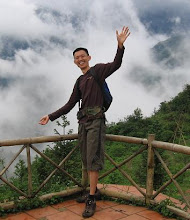
I spent January as novice monk at the Vihara Buddha Gotama monastery in Temoh, Perak. It was a most memorable and inspiring time for me; a short but important chapter in my fledging spiritual journey.

(above) Photo taken with the abbot, Venerable Dhammavuddho Thero, just before I disrobed to end 4 weeks of noviciation. Venerable Dhammavuddho is a Malaysian Chinese who was an electrical engineer before renouncing to be a Buddhist monk in 1983. He has written many booklets on Buddhism and advises Buddhists to pay more attention to the study of the original teachings of Buddha as encapsulated in the 4 earliest Nikayas (namely the Digha, Majjhima, Samyutta & Anguttara Nikayas - a Nikaya is a collection of Buddha's teachings). He raises an interesting point whereby while most Christians and Muslims have a copy of the Bible and the Quran respectively, it's sad that few Buddhists own a set of the 4 Nikayas.

(above) The 3 novices (left to right): Goh, myself & John. By tradition, juniors are to keep their seniors on the right, hence Goh (who ordained as novice earlier and therefore my senior) on my right and John (who ordained a week after me) on my left. The monastery is a Theravada Buddhism monastery following the Thai Forest Tradition. Theravada Buddhism is the oldest branch of Buddhism that has survived and is the form of Buddhism practised by the majority in Thailand, Sri Lanka, Myanmar, Laos, Cambodia and the Dai people of Yunnan in China.
****************************************************
****************************************************
VIHARA BUDDHA GOTAMA
The following photos taken around Vihara Buddha Gotama, a 15 acre monastery in Temoh, Perak, established in 1998. The Thai Forest Tradition emphasizes on living in secluded wilderness, on meditation practice and on strict observance of the rules for monks (Vinaya rules); in short, staying as close as possible to how monks practised during the Buddha's time. Hence Vihara Buddha Gotama is located on hilly grounds next to the jungle.
Vihara Buddha Gotama schedule:
3.30am Wake up call
4.30am to 6.30am Morning group meditation
6.30 am Preparation for breakfast
7am Breakfast followed by clean up and sweeping of monastery grounds.
The monk & novice scheduled for pindapat (alms round) to depart at 7.45am
10.30am to 12.30pm Lunch followed by clean up and other duties
11.30am to 12.30pm Time set aside for consulting with abbot
12.30pm to 4pm Time for individual study and meditation practice
4pm to 4.30pm Group chanting
4.30pm to 7pm Evening group meditation
7.30pm to 9pm Dhamma & Vinaya (Buddha's teaching & rules for monks) studies
9.30pm Lights out

(above) Main building of Vihara Buddha Gotama. The main hall is on the ground floor, the kitchen at the rear and a row of toilets & bathrooms on the right. The 2nd floor is the abbot's office, library and dormitory style rooms for male lay meditators. A separate 2 storey building at the back is the quarters for Buddhist nuns and female lay meditators. Buddhists and non-Buddhists who are open-minded are welcomed to stay for meditation practice and to study Buddhism on short term (a few days) or longer (weeks or months) basis.

(above) A Bodhi tree in front of the main building. The Buddha attained enlightenment while seated meditating under a similar tree. A Bodhi tree's leaf is heart shaped.

(above) The library which is stocked with the 4 original Buddhist Nikayas, other Theravada Buddhism books, Mahayana Buddhism books, Tibetan Buddhism books, books written by atheists, books on other religions (including the Bible & the Quran), medical textbooks like Gray's Anatomy (meditators view the photos of dissected body parts and picture the images in the mind during meditation on the foulness of the body), dictionaries (Pali to English, Buddhist terminology, etc.) and other books.

(above) The road leading to the hilltop 'kutis' (monks' living quarters)


(above) Kuti No. 9, where I stayed. The kutis of Vihara Buddha Gotama do not have electricity supply. Water for the kutis and everywhere within the monastery is sourced from a stream in the nearby hills. Kuti No. 9 has an accessible flat roof, so washed robes can be hung for super quick drying in the sun.


************************************************************
************************************************************
PINDAPAT (ALMS ROUND)
Monks & novices go on alms round emulating the over 2,500 years practice started by Buddha and the pioneer member of the order of monks. Alms round is done walking barefoot, while maintaining mindfullness, humility and silence. The outer robe is worn slightly different, covering both shoulders instead of the regular exposed right shoulder way. Each morning, a monk & a novice will be driven to specific villages & towns to begin the alms round. Lay practitioners, also barefooted, follow closely behind to collect the offerings that has been passed to the monks and put them in the van. Some devout supporters prepare tiffin carriers to be reused every week. Offering of alms food to the order of monks brings merit to the offerer.
Monks & novices go on alms round emulating the over 2,500 years practice started by Buddha and the pioneer member of the order of monks. Alms round is done walking barefoot, while maintaining mindfullness, humility and silence. The outer robe is worn slightly different, covering both shoulders instead of the regular exposed right shoulder way. Each morning, a monk & a novice will be driven to specific villages & towns to begin the alms round. Lay practitioners, also barefooted, follow closely behind to collect the offerings that has been passed to the monks and put them in the van. Some devout supporters prepare tiffin carriers to be reused every week. Offering of alms food to the order of monks brings merit to the offerer.
Note, money is not accepted as offerings as this is forbidden under rules for monks. Hence any 'monks' walking around town begging for money or selling amulets, etc are fake monks.
WEEKLY SCHEDULE OF ALMS ROUND
Monday: Temoh & Mambang Di Awan
Tuesday: Chenderiang, Kampung Pahang (near Tapah) and a section of Taman Tapah.
Wednesday: Tapah town and another section of Taman Tapah
Thursday: Kampung Baru Stesen Bidor
Friday: Kampar town
Saturday & Sunday: no alms round but supporters will come to offer food
(below) The following are photos taken during alms round in Kampar town.


(below) Food collected during alms round is offered by lay practitioners to monks & novices during lunch. Offering food to monks will accrue merit to the person offering. Then the lay practitioners, supporters and visitors will partake of the food. Excess food is kept for the next day.

*******************************************************
*******************************************************
(below) This photo was taken when Czech monk, Venerable Gavesako (2nd from left back row) visited Vihara Buddha Gotama. He was in Malaysia for the 'Ajahn Chah rememberence day' held in Kuala Lumpur. The late Venerable Ajahn Chah was the former abbot of Wat Pa Pong in Ubon Ratchathani, Northeast Thailand and he set up Wat Pa Nanachat with the help of his American disciple Venerable Ajahn Sumedho. Wat Pa Nanachat is a monastery specially set up to train Buddhist monks of foreign birth.
The photo banner on the right is of the late Venerable Ajahn Chah. The photo banner on the left is of the late Venerable Ajahn Mun, who was one of Ajahn Chah's teachers and a monk instrumental in reviving the Thai Forest Tradition practice. Both masters are highly respected in Thailand as well as overseas.


************************************************************
************************************************************
PHOTOS FROM JULY 2009 VASSA NOVICIATION PROGRAM
In July 2009, 8 novice monks were ordained in conjunction with the 3 months rains retreat (Vassa). During the Vassa, monks do not travel and stay put in monasteries. This practice started during Buddha's time in India to prohibit traveling during the rainy season whereby monks may damage crops that are beginning to grow. Vihara Buddha Gotama runs a 3 month noviciation program during Vassa. During other times, you can request to be ordained as novice monk for shorter duration, with the current minimum being 1 month.
(below) A tray of offering to be presented to the noviciate to the order of monks; in this example, flowers, incense, candles, lighter, honey, coffee and prunes.


(below) Offering trays are laid out in front of monks platform before commencement of noviciation ceremony.

(below) Noviciates already shaven and in white, waiting for the ceremony to begin.

(below) 3 bows, each for the Buddha, Dhamma (Buddha's teaching) & Sangha (order of monks)
respectively.

(below) Presenting tray of offerings to the abbot who is representing the order of monks.

(below) Midway the ceremony, the novices withdraw to change into the saffron robes and then return to continue the ceremony.

(below) Reciting the 10 precepts (rules to be observed) with the abbot as preceptor

(below) Ceremony ends and time for a group photo...


The 10 PRECEPTS to be observed by novice monks during noviciation period are:
1. I undertake the precept to refrain from destroying living creatures (killing).
2. I undertake the precept to refrain from taking that which is not given (stealing or taking without permission).
3. I undertake the precept to refrain from sexual activity.
4. I undertake the precept to refrain from incorrect speech (lying, slander, gossip & harsh speech).
5. I undertake the precept to refrain from intoxicating drinks and drugs which lead to carelessness.
6. I undertake the precept to refrain from eating after mid-day (sun at highest point, about 1pm).
7. I undertake the precept to refrain from dancing, singing, music, going to see entertainment (like TV, sports, games, etc).
8. I undertake the precept to refrain from wearing garlands, using perfumes, and beautifying the body with cosmetics. (ie to dress up for vanity's sake)
9. I undertake the precept to refrain from lying on a high or luxurious sleeping place. (ie. luxurious comfortable beds or chairs)
10. I undertake the precept to refrain from accepting money.
*****************************************************************
*****************************************************************
FOR MORE DETAILS ON ARRANGING STAY AT or TO SUPPORT VIHARA BUDDHA GOTAMA,
visit the monastery's website http://www.vbgnet.org/